Zawar: India’s 3,000-year-old Mining Legacy, Reinvented by Hindustan Zinc
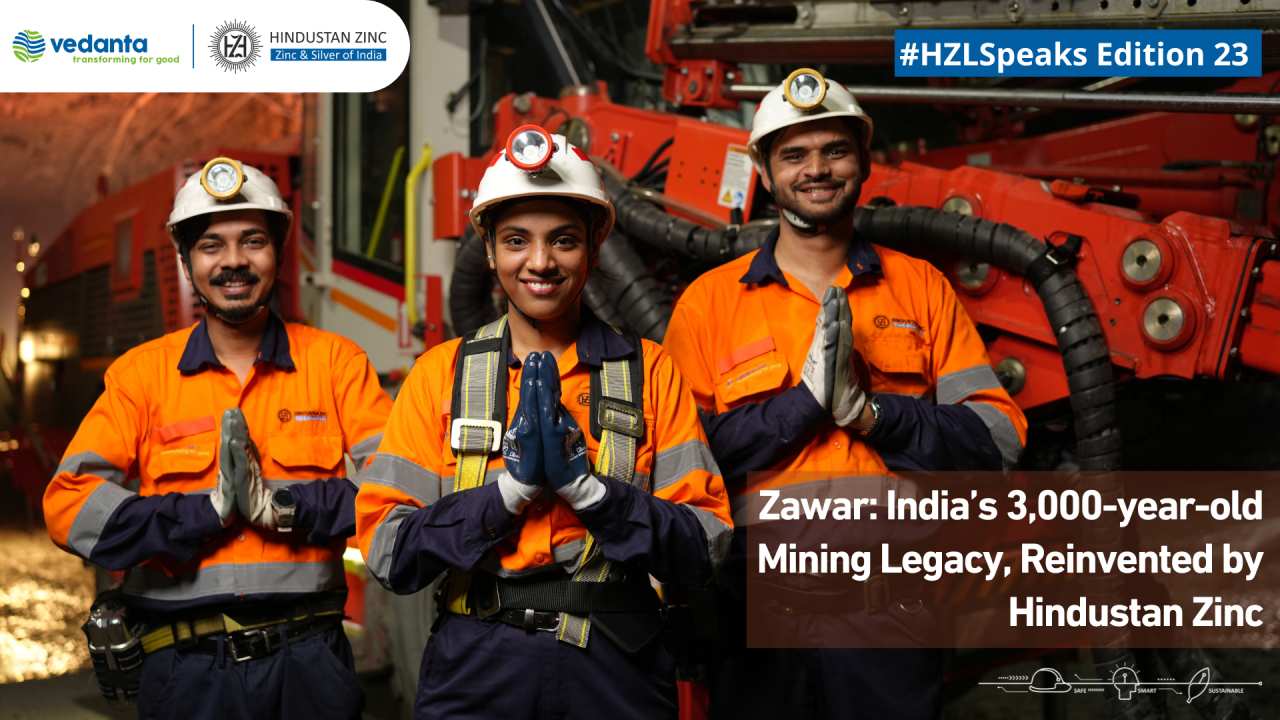
What if we told you that the birthplace of global zinc metallurgy isn’t in Europe or China but in the heart of Rajasthan, India? That while the West was still deciphering zinc in the 18th century, Indian metallurgists had already cracked its secrets nearly three millennia ago? Welcome to Zawar – the world’s oldest known zinc mining and smelting site, and the backbone of India’s scientific legacy. In this edition of #HZLSpeaks, we explore how Hindustan Zinc is not only preserving this ancient marvel but also transforming it into a global benchmark of innovation-led mining.
Long before Europe discovered zinc, India was already exporting it. Long before the word ‘metallurgy’ was coined, Zawar in Udaipur district, Rajasthan was perfecting it. Nestled within the mineral-rich folds of the Aravalli hills lies Zawar – the world’s oldest known site of zinc mining and smelting, a living testament to India’s ancient technological prowess. Archaeological discoveries trace large-scale zinc production in Zawar to as early as 750 BCE (Before Common Era), with some evidence suggesting metallurgical activity began nearly 2,750 BCE. While Europe was still experimenting with zinc production in the 18th century, Zawar’s Bhil community had already mastered it using techniques that shaped global metallurgy. In ancient India, Zawar was exporting zinc globally to produce brass and coins. This extraordinary legacy finds its modern custodian in Hindustan Zinc, a Vedanta Group company, which today is the world’s largest integrated zinc producer — meeting 77% of India’s zinc demand and supplying to more than 40 countries worldwide. Zinc is a critical metal, primarily used in the steel industry to protect steel from corrosion. India loses approximately 5% of its GDP each year due to corrosion – a loss that can be significantly mitigated through the application of zinc.
Zawar is more than just an ancient mining site — it is a geological time capsule. The brilliance lay in the unique reverse distillation technique developed by Zawar’s metallurgists, a process involving precise temperature control, water-cooled chambers and intricately crafted brinjal-shaped clay retorts coated with turmeric for durability. These inverted pots enabled the collection of pure zinc vapour and the production of high-quality zinc. Today, scattered remnants of these ancient retorts can be found all around Zawar, narrating a phenomenal story of ancient scientific innovation.
Mining activity in Zawar briefly paused in 1812 due to the challenges posed by deeper ore bodies and prevailing socio-political unrest. However, its revival came in 1966, when Hindustan Zinc reignited the site’s legacy. Today, Zawar thrives as a hub of innovation-led mining, where age-old wisdom and rich ore body meet cutting-edge technology. Today, Hindustan Zinc produces more than 2 lakh tonnes of zinc metal in concentrate (fine powder produced from ore). Hindustan Zinc uses the world’s top technology such as drone based underground exploration, borehole electromagnetics (exclusively deployed by Hindustan Zinc in India), geophysical surveys and AI-driven 3D modelling to identify new reserves and execute sustainable mining. From ancient methods to advanced exploration technology, every advancement has improved precision and enhanced ore production. Zawar reflects the perfect synthesis of India’s ancient mining knowledge with modern technological progress.
A defining chapter in Zawar’s modern era was scripted in 2002, when Vedanta Group acquired equity stake in Hindustan Zinc. This landmark move is regarded as one of the most successful disinvestments by the Indian government. Under Vedanta’s leadership, Hindustan Zinc underwent strategic capital infusion, embraced global best practices and fostered a culture of technological innovation. Mining efficiencies reimagined, smelting processes were modernized and technological integration became the cornerstone of operations. Interestingly, Zawar has witnessed a phenomenal 4-times growth since disinvestment. In 2016, the Geological Society of India declared Zawar a National Geological Heritage Site in recognition of its legacy.
In today’s world, where the transition to clean energy has become a global imperative, zinc has emerged as a critical enabler — powering batteries, strengthening infrastructure and driving automotive innovation. From an ancient tribal innovation to a globally significant industrial operation, Zawar’s journey stands as a testament to the enduring supremacy of India’s metallurgical excellence. This mine, along with the company’s other four mines, has made Hindustan Zinc the world’s largest integrated zinc producer and India’s only zinc & silver producer. The company not only preserving this civilizational legacy but also propelling innovation for a sustainable future. Zawar’s zinc is far more than an industrial resource; it is India’s ancient gift to its future progress.