The Zinc Fortress: How Geopolitics Reshapes India’s Mineral Security
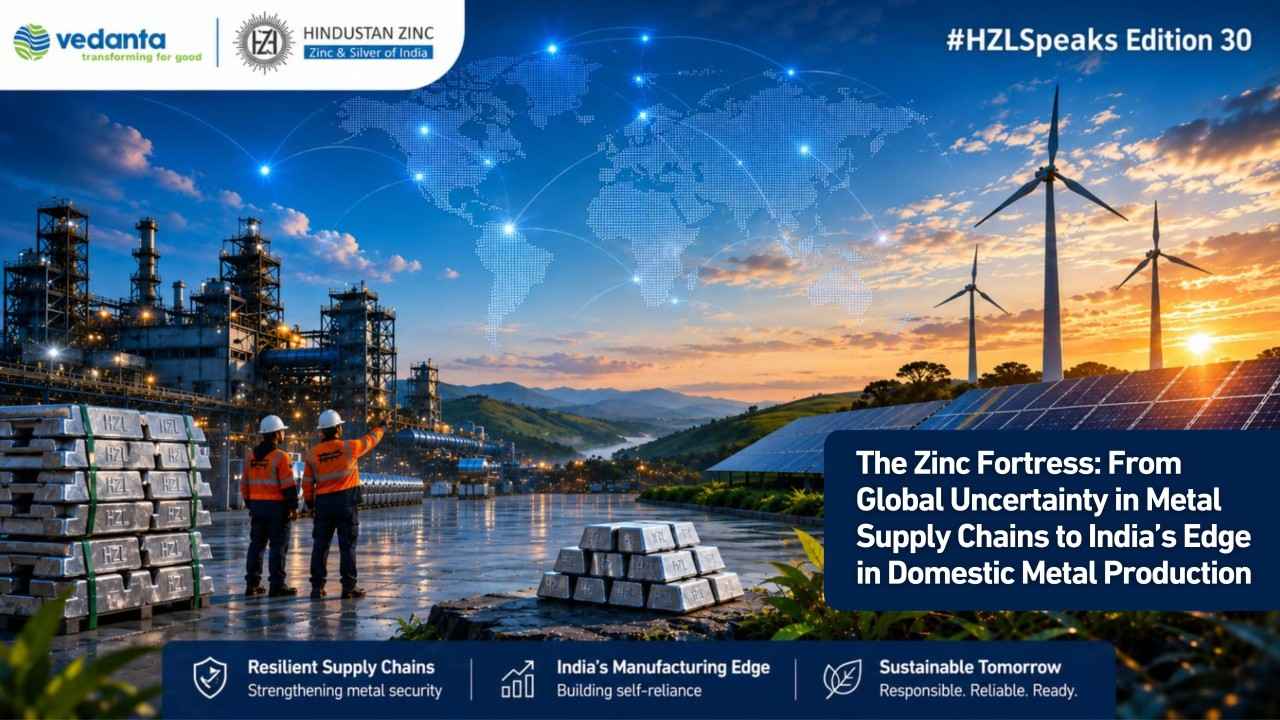
The Zinc Fortress: How Geopolitics Reshapes India’s Mineral Security
Metal’s mood swings are here igniting one important question – how volatile global supply chains are shaking things up, and why India’s strong domestic production has us cutting through the chaos!
When global supply chains fracture, the nations that survive are those that mine their own futures. Over the last three months, renewed conflicts in West Asia and volatile energy costs have pushed the global metals market into deep uncertainty. While overseas smelters are losing money due to high energy costs and a global shortage of raw mining ore, India’s factories remain insulated on account of long-term supply contracts and reliable local power.
The reason is an asymmetry in the critical minerals race: India has built complete domestic sovereignty over zinc.
Zinc is no longer just a legacy industrial metal used to galvanize steel; it is a foundational component of the green energy transition, vital for solar trackers and next-generation grid storage. Most industrial nations rely on a hyper-fragmented supply chain, buying raw ore from one continent and shipping it to another for high-emissions smelting. This model fails during geopolitical friction.
India’s comparative advantage lies in structural integration. By anchoring its supply chain within its own borders, primarily via Rajasthan’s rich deposits, India bypasses the cross-border vulnerabilities that cripple foreign competitors. Controlling three-quarters of the domestic market, Hindustan Zinc Limited (HZL) functions as a strategic economic moat. HZL retains its competitive advantage because its operations are fully integrated from exploration to smelting. Additionally, the domestic infrastructure boom remains completely unaffected by global shipping price spikes and fuel bottlenecks.
As European and Asian smelters grapple with carbon taxes and erratic fuel supplies, India’s model demonstrates that sustainability and self-reliance are financially defensive. HZL’s structural cost protections and scaling green energy power contracts allow it to produce high-grade zinc that easily clears strict international ESG import regulations.
The disruptions of the last quarter show that mineral security cannot be outsourced. In a fragmented world, the true winners are not just those with resources in the ground, but those who control the entire value chain from pit to port. India has built a fortress around its zinc supply, and the rest of the world is now forced to take notice.
Carbon Borders, Coated Steel: Why Zinc Is Winning the CBAM Era
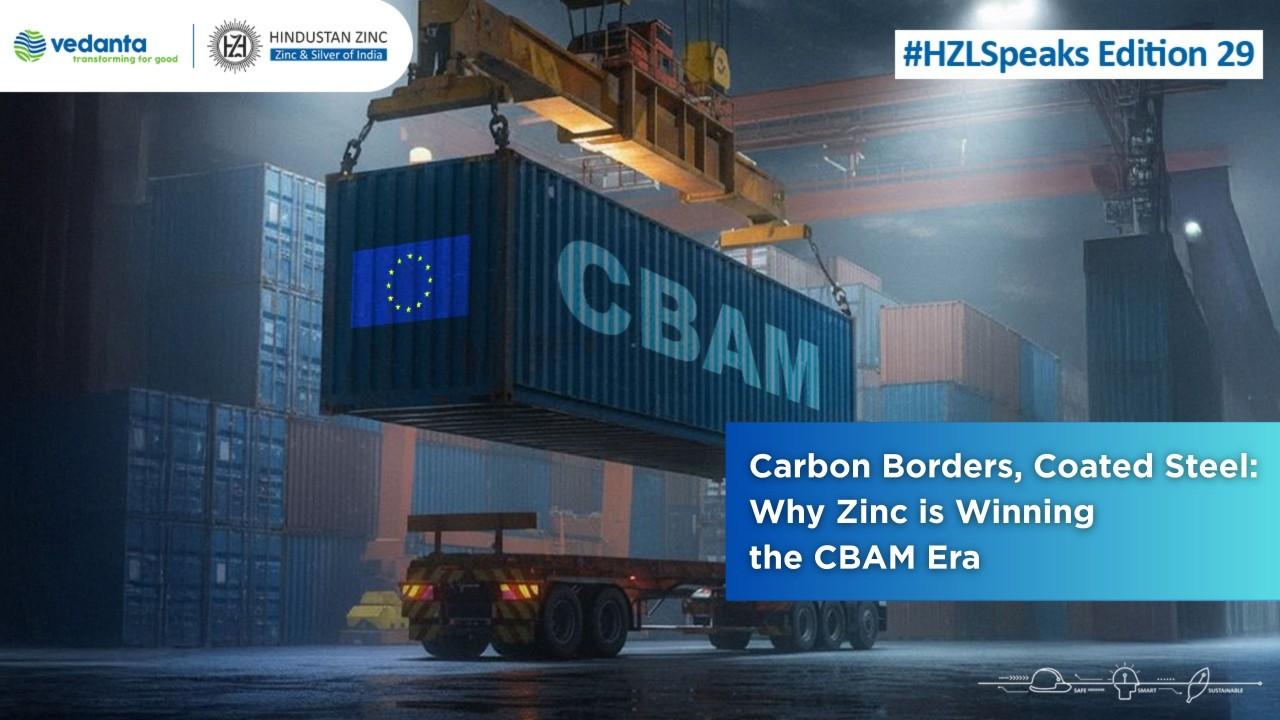
Carbon Borders, Coated Steel: Why Zinc Is Winning the CBAM Era
What if the future of global trade is decided not just by what you produce, but how long it lasts?
In this edition of #HZLSpeaks, we explore how Europe’s Carbon Border Adjustment Mechanism (CBAM) is reshaping metal choices across industries and why zinc is emerging as a strategic advantage in a carbon-conscious world.
CBAM is more than a trade policy; it is reshaping the competitiveness of industrial metals. By attaching a carbon cost to imported goods like steel, it rewards producers who can demonstrate lower lifecycle emissions. This fundamentally changes the equation, from cost efficiency alone to durability, longevity, and embedded carbon.
This is where zinc plays a defining role.
A majority of global zinc consumption goes into galvanization, coating steel to protect it from corrosion. While the science is simple, the impact is significant. A thin layer of zinc can extend the life of steel by decades, reducing the need for frequent repairs, replacements, and resource-intensive rebuilds. In a CBAM-driven world, this translates directly into lower cumulative emissions over an asset’s lifecycle.
For sectors like infrastructure, renewable energy, transmission, and automotive, this advantage is no longer optional; it is strategic. As carbon accounting becomes stricter, materials that deliver longevity without increasing emissions will define competitiveness.
Taking this a step further, Hindustan Zinc’s EcoZen, Asia’s first low-carbon zinc, redefines what sustainable galvanization can look like. Produced using 100% renewable energy, EcoZen has a carbon footprint of less than 1 tonne of CO2 per tonne of zinc, nearly 75% lower than the global average. This enables manufacturers to meaningfully reduce the embedded carbon of their products while maintaining performance and durability.
In essence, EcoZen allows industries to not just comply, but lead.
At the same time, zinc demand is steadily transitioning from being purely cyclical to structurally supported. With carbon pricing mechanisms gaining ground globally, demand for materials that enable longer asset life and lower emissions is becoming policy-driven. This positions zinc, particularly low-carbon zinc, as a critical enabler of the next industrial cycle.
CBAM does not explicitly mandate zinc. But it rewards exactly what zinc delivers, longevity, efficiency, and lower lifecycle emissions.
For Indian exporters and global manufacturers navigating this new landscape, the message is clear: competitiveness will be built not just on what you make, but how responsibly, and how durably, you make it.
HZL Anchoring Amid Global Pricing Benchmarks
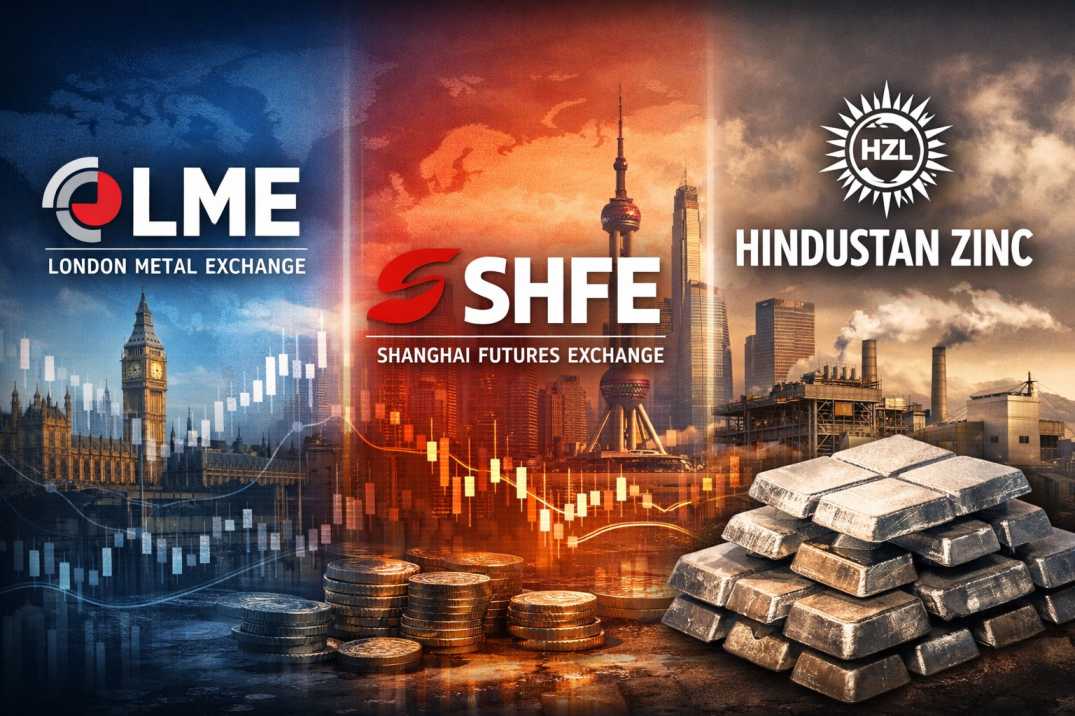
HZL Anchoring Amid Global Pricing Benchmarks
“I go and look at my zinc-bed
there. After all, I had a wonderful life, which is, I fear, over.” – Oscar
Wilde
Oscar Wilde’s melancholic
reflection reminds us that Zinc, though often overlooked, has long been woven
into the fabric of human life. From art and literature to science and industry,
zinc has played a silent yet powerful role. Today, in India, this humble metal
is not just a poetic metaphor but a cornerstone of progress — and at the heart
of this story stands Hindustan Zinc.
Zinc is more than just a metal;
it is the backbone of modern infrastructure, automotive safety, and sustainable
construction. For buyers, the price of zinc is influenced by global benchmarks
set by the London Metal Exchange (LME) and the Shanghai Futures
Exchange (SHFE). These exchanges provide international reference points for
zinc contracts, shaping procurement decisions across Asia. Yet, while these
benchmarks set the tone, it is Hindustan Zinc that ensures Industries have a
reliable, high-quality, and sustainable supply of zinc — making it the true
stabilizing force in the market.
The LME’s Special High Grade
(SHG) zinc contract, quoted in USD per metric ton, is the global standard for
zinc pricing. Indian importers and galvanizers often negotiate contracts based
on LME settlement prices, with premiums added for freight, insurance, and
logistics. Meanwhile, SHFE reflects China’s domestic demand, offering insights
into regional consumption trends. Together, these benchmarks create a global
framework that buyers must navigate. But benchmarks alone do not guarantee
security — and this is where Hindustan Zinc’s role becomes indispensable.
As the world’s second-largest
zinc producer and India’s only integrated zinc manufacturer, Hindustan Zinc
provides a domestic anchor in a volatile global market. By aligning its pricing
with LME and SHFE while ensuring consistent supply, Hindustan Zinc shields
Indian industries from excessive exposure to international uncertainty. This
means galvanizers, automotive manufacturers, and infrastructure developers can
plan procurement with confidence, knowing that their supply chain is backed by
a trusted Indian producer.
Hindustan Zinc’s leadership
extends beyond stability. The company is pioneering Ecozen, a low-carbon
zinc production, preparing India for a future where sustainability premiums
will become part of global pricing. As international buyers increasingly demand
eco-friendly metals, Hindustan Zinc’s investments in green processes ensure
that Indian industries remain competitive without being burdened by costly
imports. This forward-looking approach positions Hindustan Zinc not just as a
supplier, but as a driver of India’s sustainable growth story.
For Indian buyers, the equation
is clear: while LME and SHFE provide the benchmarks, Hindustan Zinc provides
the backbone. It translates global prices into reliable domestic supply,
reduces dependence on imports, and ensures that India’s zinc industry is
future-ready. In a market where volatility is the norm, Hindustan Zinc stands
as the stabilizing force — galvanizing India’s growth with strength,
sustainability, and security.
RaiZinc the Bar: How Galvanized Steel Is Reshaping Zinc’s Role in the Green Economy and Long-Life Infrastructure
RaiZinc the Bar: How Galvanized Steel Is Reshaping Zinc’s Role in the Green Economy and Long-Life Infrastructure
In this edition of #HZLSpeaks, we examine how galvanized (zinc-coated) steel reshapes zinc’s part in the green economy and durable infrastructure.
The global shift toward cleaner energy and resilient systems is often framed as a story of new technologies. Yet the core idea is simple: build better, build to last. Power grids, transport networks, renewables, cities, and housing are being designed for longer lifespans and tougher conditions. In this shift, zinc plays a decisive and increasingly strategic role.
Galvanized steel remains the single largest end use of zinc, accounting for well over half of global demand. That link strengthens as governments and industries scale climate-aligned investments. Whether it’s transmission towers, rail electrification, solar structures, coastal infrastructure, or urban drainage, the common requirement is steel that withstands decades of exposure. Zinc enables that durability.
At the heart of galvanization is a straightforward, powerful principle: zinc protects steel by sacrificing itself. When steel is coated through galvanization or zinc-aluminium metallisation, the zinc layer corrodes first, shielding the steel beneath even if the surface is scratched or damaged. This dramatically slows corrosion, reduces maintenance, and extends asset life. In most environments, galvanized steel can deliver 50 years or more of service.
From a climate perspective, galvanized steel supports long-life infrastructure with lower life-cycle costs, fewer replacements, and reduced emissions from maintenance. Its durability is especially valuable in harsh environments—coastal, industrial, and remote locations—where frequent repairs are costly and disruptive. As cities and assets age, the need for resilient materials grows, and galvanized steel offers a proven path to reliability.
The broader implication is clear: zinc’s value isn’t limited to a coating; it’s a strategic enabler of sustainable, resilient infrastructure. As green investments rise, galvanized steel stands as a reliable backbone, protecting infrastructure, lowering total costs, and accelerating timelines for a low-carbon future.
From Rails to Roofs: Steel That Keeps Its Promises
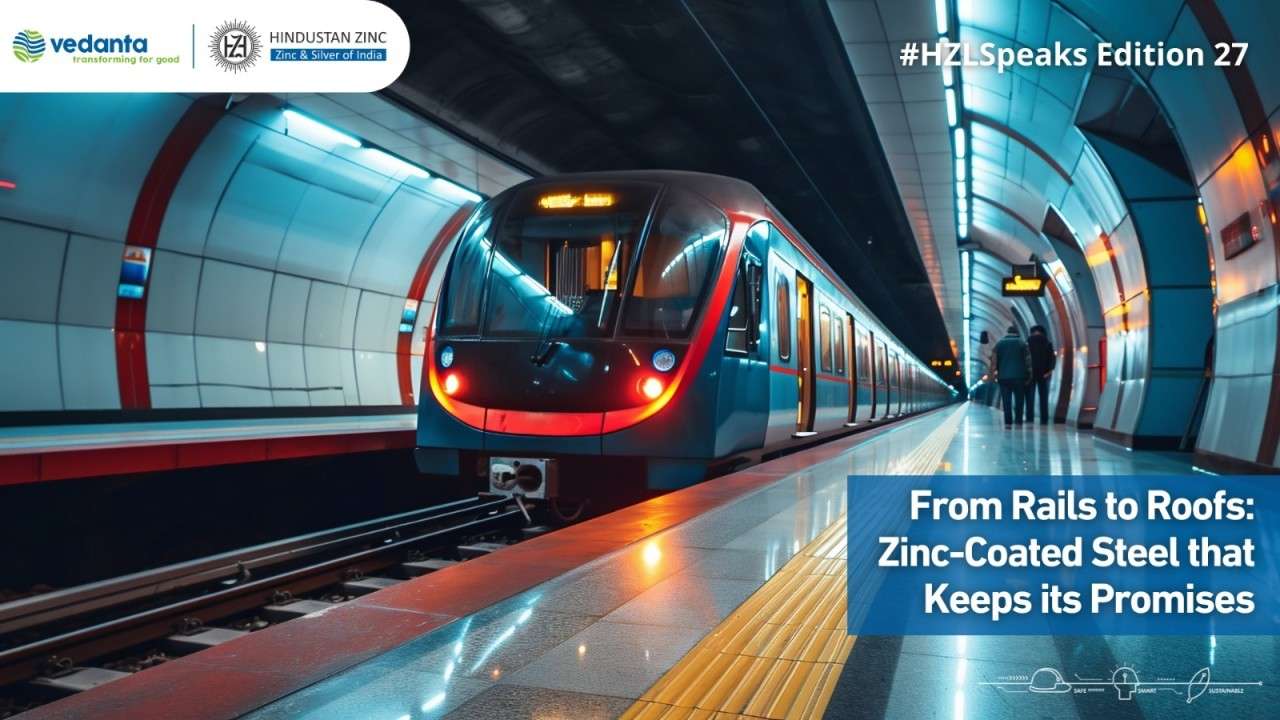
From Rails to Roofs: Steel That Keeps Its Promises
At its heart, galvanization is an insurance policy for steel. Zinc sacrifices itself to protect the metal beneath. Even when scratched, the coating corrodes first, ensuring decades of maintenance-free service. In most environments, galvanized steel delivers 50 years or more of durability—few human plans can make the same claim.
The phrase “from rails to roofs” captures both history and scale. In the 19th century, zinc-coated steel safeguarded ships and railway signals, where failure was not an option. Today, it supports the wider economy: transmission towers across states, solar structures holding panels in desert winds, road lighting columns, warehouses, homes, and factory roofs. Modern roofing systems now withstand winds up to 180 miles per hour, proving resilience in extreme conditions. The technology has traveled far, yet the principle remains unchanged: build once, repair rarely.
The economic case is equally compelling. India loses 2–4% of its GDP annually to corrosion—over ₹12 lakh crore (around $140 billion). Countries like Japan and Australia, which embraced zinc-coated steel early, have reduced such losses to a third. Studies indicate that up to 30% of corrosion damage is preventable with existing technology. Galvanization is not an exotic innovation—it’s disciplined application.
Hindustan Zinc has brought this truth to life through the #ZungKeKhilaafZinc campaign. Two motorcycles parked side by side—one rusting, one intact—made the invisible problem visible. With over 70% of a vehicle’s body made of steel, corrosion protection is not a luxury; it’s a necessity. And the cost? Less than 0.1% of a vehicle’s price, with payback in longer life, lower maintenance, and higher resale value.
Environmental questions are valid but require nuance. Hot-dip galvanization is energy-intensive, yet its long service life offsets initial inputs. Galvanized steel is fully recyclable, and lasting steel reduces the demand for new production. True sustainability lies in efficiency, not constant replacement.
As India builds at scale—railways, renewable energy, housing, mobility—the choice of zinc-coated steel becomes a policy decision, not just a technical one. Galvanized steel delivers something rare: durability that makes economic sense and serves national interest. Resolutions may fade, but zinc-coated steel will continue to keep its promise.
Selected sources
- World Corrosion Organization – Global and national corrosion cost estimates: WCO – World Corrosion Organization – Publications
- International Zinc Association – Zinc and galvanization in infrastructure
- Journal of Cleaner Production (2020): Life-cycle assessment of hot-dip galvanisation Life-cycle assessment as a tool to evaluate the environmental impact of hot-dip galvanisation – ScienceDirect
- Indian Railways / RDSO specifications on zinc-coated steel applications: rdso.indianrailways.gov.in/uploads/files/scan0004.pdf
India on Track: How Zinc-Coated Steel Is Reinventing Railway Safety and Longevity
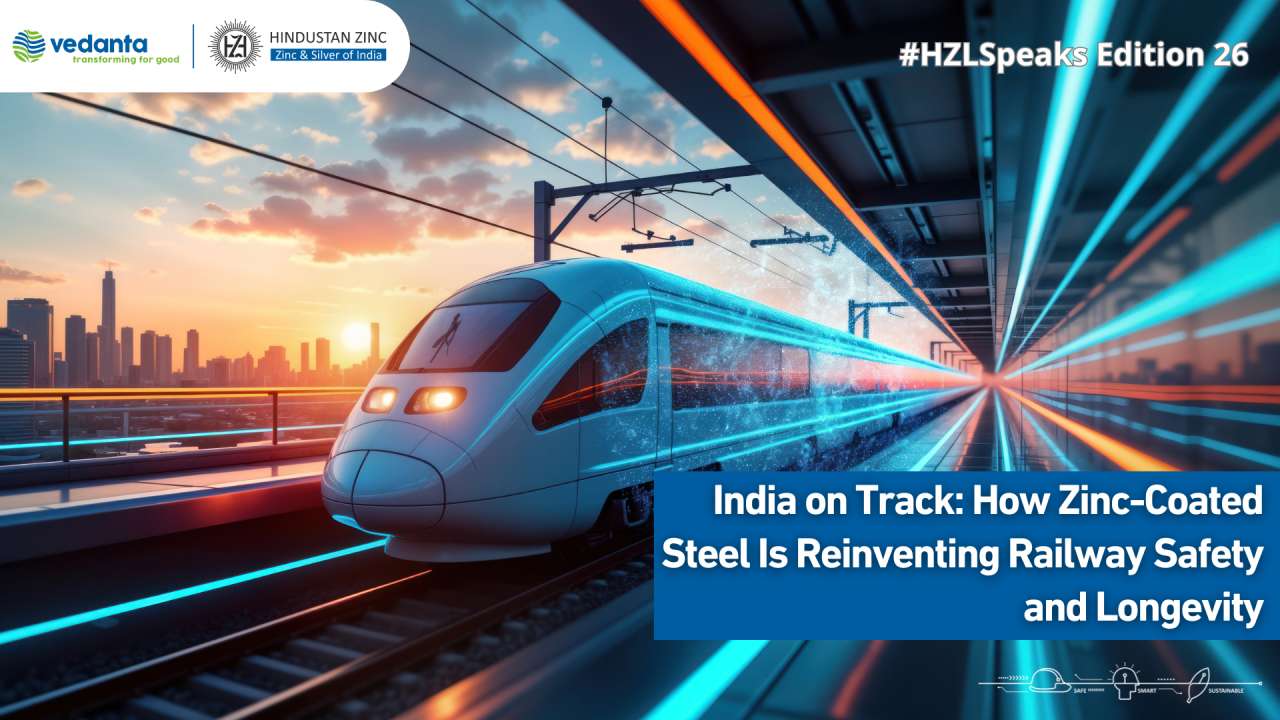
India on Track: How Zinc-Coated Steel Is Reinventing Railway Safety and Longevity
In this edition of #HZLSpeaks, we explore a simple but powerful question: what keeps India’s railways safe, reliable, and ready for the future…through monsoons, heatwaves, and decades of non-stop use?
Indian Railways today runs on speed, scale, and precision. Trains are faster. Loads are heavier. Safety margins are tighter than ever. In this environment, the performance of track materials isn’t a technical detail, it’s a strategic decision.
One of the biggest challenges has always been corrosion. Moisture, coastal salinity, industrial pollution, and temperature swings steadily weaken exposed steel. In many regions, rail components designed to last over a decade can deteriorate far sooner, increasing maintenance cycles, costs, and operational risk.
Zinc-coated steel offers a proven way forward. Through galvanization, steel is protected by a durable coating that shields it from the elements. Zinc also provides sacrificial protection…meaning it corrodes first, safeguarding the steel underneath even if the surface is scratched. In corrosion-prone conditions, this can extend component life from around 12 years to 30 years or more.
The impact is tangible. Better corrosion resistance means fewer failures, reduced downtime, and lower lifecycle costs. For a rail network of this scale, that translates into stronger reliability, improved safety, and smarter use of public investment.
This is not a theoretical shift. Research Design and Standards Organization has issued specifications for zinc coatings after extensive trials, and approvals are in place for corrosion-prone regions. Globally, rail networks in Europe have long adopted similar solutions in demanding operating environments.
As India accelerates high-speed services like Vande Bharat and prepares for future bullet train corridors, corrosion-resistant infrastructure becomes foundational. Track stability, precision, and minimal downtime are non-negotiable.
For Indian Railways, staying on track means building for longevity.
And zinc-coated steel is fast becoming a key enabler of a safer, stronger, and future-ready rail network
Behind the Premium: Why European Zinc Pricing Holds Clues for India’s Next Galvanizing Boom
Behind the Premium: Why European Zinc Pricing Holds Clues for India’s Next Galvanizing Boom
When people talk about European zinc prices, it often sounds like something far removed from India’s everyday industrial reality. Different markets. Different economies. Different priorities. But in reality, what happens to zinc prices in Europe quietly shapes the cost, durability, and lifespan of India’s infrastructure. In this edition of #HZLSpeaks, let’s explore this through our #AmaZinc lens.
Zinc traded on the London Metal Exchange (LME) is the global benchmark. In India, zinc prices move closely in line with it through the Multi Commodity Exchange (MCX). This means global price movements travel fast—right into the balance sheets of Indian galvanizers, automakers, EPC players, and infrastructure developers. A price movement thousands of kilometers away can influence project economics here almost overnight.
Why does this matter so much? Because zinc isn’t just another industrial metal. It is the backbone of corrosion protection.
Every bridge that stands longer, every transmission tower that resists rust, every highway railing, solar structure, rail coach, or car body that survives harsh weather owes its durability to galvanized steel. Zinc protects steel from corrosion, extending its life and reducing maintenance costs. When zinc prices are stable, galvanization becomes easier to adopt at scale. When prices rise sharply, short-term cost pressures can slow decisions—especially if lifecycle value is overlooked.
European zinc prices don’t move randomly. They reflect global signals: mine closures, supply disruptions, changes in inventory levels at LME warehouses, energy costs, and shifting demand expectations. Investor sentiment amplifies these trends when stocks are tight or future demand looks strong. For India—a fast-growing steel and infrastructure economy—treating zinc pricing as purely domestic misses the bigger picture.
The opportunity gap is striking. India’s per capita zinc consumption is about 0.5 kg. The global average is close to 4 kg, and Europe consumes more than 6 kg per person. This isn’t just a statistic—it signals underutilization. Today, India loses nearly 5% of its GDP every year to corrosion-related damage to infrastructure and public assets. That’s money spent repairing, repainting, rebuilding—often far earlier than necessary.
Wider use of galvanized steel changes this equation. It lowers lifecycle costs, improves returns on infrastructure investment, and reduces premature replacement. Corrosion protection is no longer a technical footnote; it is an economic imperative.
As India builds highways, rail corridors, logistics parks, renewable energy assets, coastal infrastructure, and dense urban housing, durability must be designed in from day one. Galvanized steel reduces downtime, maintenance cycles, and long-term taxpayer burden. For planners, developers, and financiers, it is a compelling value proposition.
We are entering a decisive decade for India’s infrastructure story. Understanding global zinc price trends—especially in Europe—helps stakeholders plan procurement better, manage cost expectations, and design assets for performance over decades, not just completion timelines. Even a moderate increase in galvanization adoption can raise domestic zinc demand, create scale efficiencies, and stabilize input economics over time.
For Hindustan Zinc, global pricing environments matter. But the larger national opportunity lies beyond price cycles. It lies in a structural shift towards corrosion-resistant, longer-lasting steel. Tracking European zinc pricing is not about trading metals—it is about reading signals that can help India time, plan, and accelerate its galvanization journey.
Because when steel lasts longer, infrastructure works harder and the economy saves more.
Ohh what fun it is to ride on zinc coated steel, everyday!
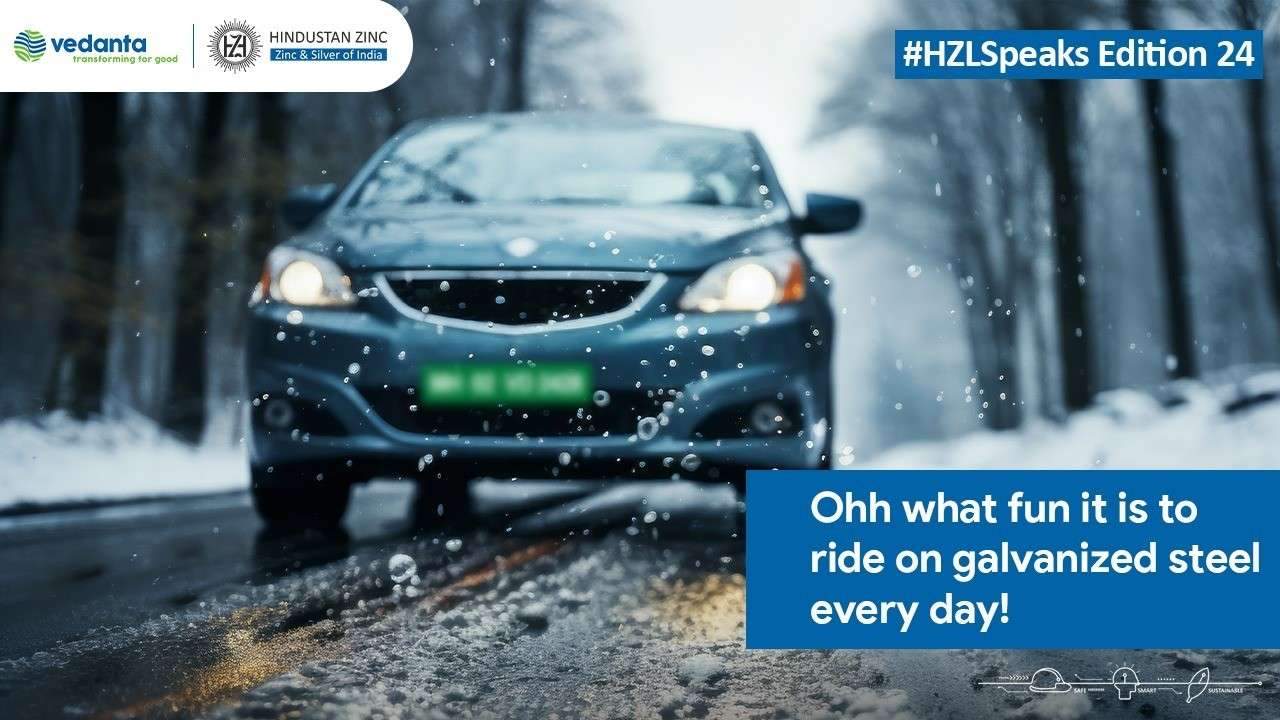
Ohh what fun it is to ride on zinc coated steel, everyday!
Your vehicle is galvanized, and corrosion is away, you enjoy winter trips singing jingles all the way.
As families are gearing up for holiday trips, so are their vehicles. If your winter trips are the cozy warmth of cake, then a galvanized vehicle is the lasting, protective “cherry on top.”
Zinc galvanization (coating) is the one technology that keeps journeys worry-free by protecting steel. A thin coat of zinc may not glitter like tinsel, but it protects the very bones of a vehicle making it more durable, safer, and worth more at resale.
Winter and festive travel raise the stakes. Fog, dew and larger temperature swings increase moisture exposure. With chilly weather comes the perfect storm for corrosion, moisture from fog, dew that clings to your ride, and those wild temperature swings that Mother Nature loves to throw our way. Especially in humid regions and hilly areas where roads are tougher, your vehicle faces a daily battle against rust.
Enter zinc the knight in shining armor, guarding your vehicle against harsh winters. This zinc coating forms an invisible fortress that not only blocks moisture and oxygen but also sacrifices itself to keep your fancy ride safe, a process known as sacrificial protection. This means zinc doesn’t just sit on the surface—it actively corrodes first, preserving the steel underneath even when scratched or damaged. The result? Vehicles that stay durable, reliable, and safe through all your winter adventures.
And it’s not just about protection; it’s smart economics too. Today’s vehicle owners are investing in long-term health, seeking anti-corrosion warranties and better resale values. Galvanized steel answers that call, reducing maintenance hassles and ensuring your ride looks as good as new… years down the road. With zinc-coated steel parts, the rate of rust formation slows down, lowering repair costs and increasing vehicle lifespan, savings that modern consumers increasingly value.
This festive season, when families pack their bags for long-distance journeys, galvanized steel works 24/7 behind the scenes to keep engines roaring and wheels rolling. From body panels to underbody structures, Zinc plays a powerful role in shielding the most vulnerable components during harsh winter conditions.
But the magic doesn’t stop there. When policymakers and manufacturers align on clear benchmarks and incentives for higher zinc galvanization levels, the whole industry benefits. Think of it as a holiday pact: tougher Indian standards matching global export norms means cars that aren’t just durable but truly competitive on the world stage. Greater zinc usage also supports the shift toward safer, longer-lasting mobility solutions, an investment that boosts both national quality standards and consumer confidence.
So, as you unwrap gifts this season, remember this simple change with outsized returns. A zinc-charged shield will only cost 0.1% of the overall vehicle cost but its impact echoes in every safe journey you take. Powered by Hindustan Zinc, the world’s largest integrated producer of zinc…here’s to a season of protection, innovation, and lasting confidence, because sometimes, the best gifts are the ones you don’t see.
Zawar: India’s 3,000-year-old Mining Legacy, Reinvented by Hindustan Zinc
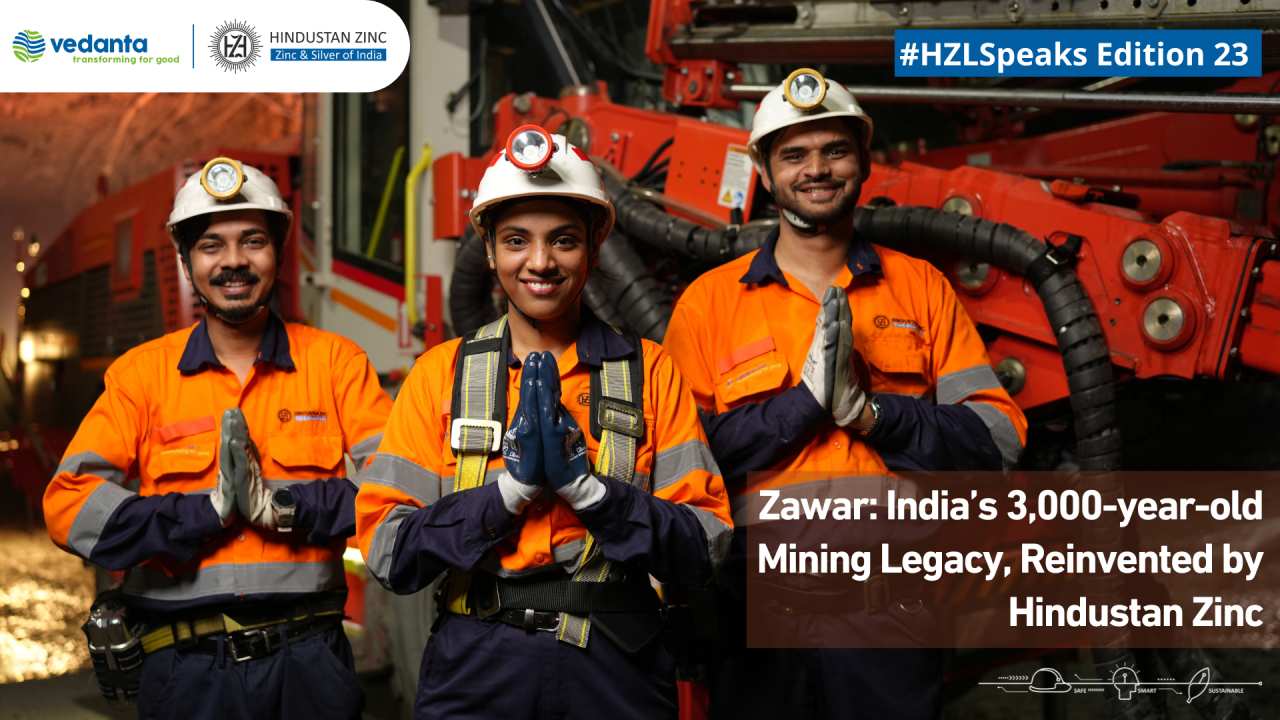
Zawar: India’s 3,000-year-old Mining Legacy, Reinvented by Hindustan Zinc
What if we told you that the birthplace of global zinc metallurgy isn’t in Europe or China but in the heart of Rajasthan, India? That while the West was still deciphering zinc in the 18th century, Indian metallurgists had already cracked its secrets nearly three millennia ago? Welcome to Zawar – the world’s oldest known zinc mining and smelting site, and the backbone of India’s scientific legacy. In this edition of #HZLSpeaks, we explore how Hindustan Zinc is not only preserving this ancient marvel but also transforming it into a global benchmark of innovation-led mining.
Long before Europe discovered zinc, India was already exporting it. Long before the word ‘metallurgy’ was coined, Zawar in Udaipur district, Rajasthan was perfecting it. Nestled within the mineral-rich folds of the Aravalli hills lies Zawar – the world’s oldest known site of zinc mining and smelting, a living testament to India’s ancient technological prowess. Archaeological discoveries trace large-scale zinc production in Zawar to as early as 750 BCE (Before Common Era), with some evidence suggesting metallurgical activity began nearly 2,750 BCE. While Europe was still experimenting with zinc production in the 18th century, Zawar’s Bhil community had already mastered it using techniques that shaped global metallurgy. In ancient India, Zawar was exporting zinc globally to produce brass and coins. This extraordinary legacy finds its modern custodian in Hindustan Zinc, a Vedanta Group company, which today is the world’s largest integrated zinc producer — meeting 77% of India’s zinc demand and supplying to more than 40 countries worldwide. Zinc is a critical metal, primarily used in the steel industry to protect steel from corrosion. India loses approximately 5% of its GDP each year due to corrosion – a loss that can be significantly mitigated through the application of zinc.
Zawar is more than just an ancient mining site — it is a geological time capsule. The brilliance lay in the unique reverse distillation technique developed by Zawar’s metallurgists, a process involving precise temperature control, water-cooled chambers and intricately crafted brinjal-shaped clay retorts coated with turmeric for durability. These inverted pots enabled the collection of pure zinc vapour and the production of high-quality zinc. Today, scattered remnants of these ancient retorts can be found all around Zawar, narrating a phenomenal story of ancient scientific innovation.
Mining activity in Zawar briefly paused in 1812 due to the challenges posed by deeper ore bodies and prevailing socio-political unrest. However, its revival came in 1966, when Hindustan Zinc reignited the site’s legacy. Today, Zawar thrives as a hub of innovation-led mining, where age-old wisdom and rich ore body meet cutting-edge technology. Today, Hindustan Zinc produces more than 2 lakh tonnes of zinc metal in concentrate (fine powder produced from ore). Hindustan Zinc uses the world’s top technology such as drone based underground exploration, borehole electromagnetics (exclusively deployed by Hindustan Zinc in India), geophysical surveys and AI-driven 3D modelling to identify new reserves and execute sustainable mining. From ancient methods to advanced exploration technology, every advancement has improved precision and enhanced ore production. Zawar reflects the perfect synthesis of India’s ancient mining knowledge with modern technological progress.
A defining chapter in Zawar’s modern era was scripted in 2002, when Vedanta Group acquired equity stake in Hindustan Zinc. This landmark move is regarded as one of the most successful disinvestments by the Indian government. Under Vedanta’s leadership, Hindustan Zinc underwent strategic capital infusion, embraced global best practices and fostered a culture of technological innovation. Mining efficiencies reimagined, smelting processes were modernized and technological integration became the cornerstone of operations. Interestingly, Zawar has witnessed a phenomenal 4-times growth since disinvestment. In 2016, the Geological Society of India declared Zawar a National Geological Heritage Site in recognition of its legacy.
In today’s world, where the transition to clean energy has become a global imperative, zinc has emerged as a critical enabler — powering batteries, strengthening infrastructure and driving automotive innovation. From an ancient tribal innovation to a globally significant industrial operation, Zawar’s journey stands as a testament to the enduring supremacy of India’s metallurgical excellence. This mine, along with the company’s other four mines, has made Hindustan Zinc the world’s largest integrated zinc producer and India’s only zinc & silver producer. The company not only preserving this civilizational legacy but also propelling innovation for a sustainable future. Zawar’s zinc is far more than an industrial resource; it is India’s ancient gift to its future progress.
Your Car Could Be Rusting Right Now, And This Monsoon Will Make It Worse!
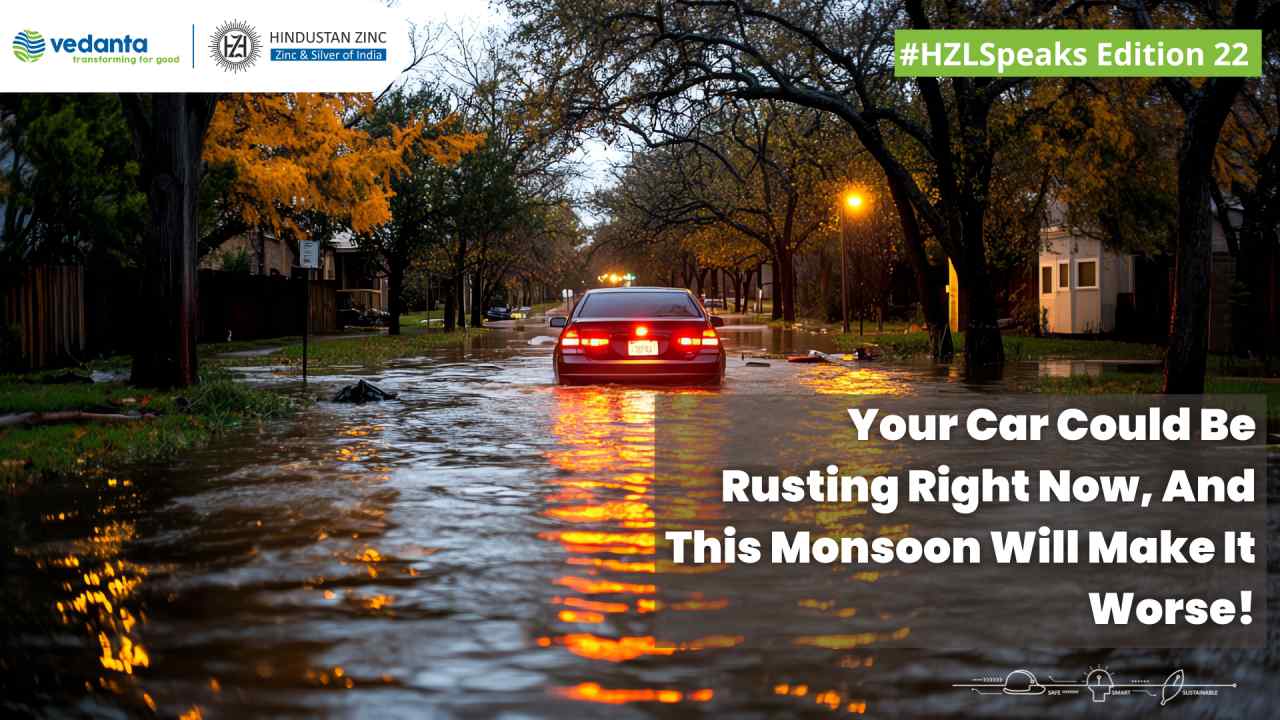
Your Car Could Be Rusting Right Now, And This Monsoon Will Make It Worse!
Would you buy a car with premium interiors, hi-tech features, and a rusting skeleton? That’s the hidden trade-off most Indian car buyers unknowingly make every day. While Indian consumers splurge on sunroofs, infotainment systems, and alloy wheels, the car’s core – the steel body, often lacks the basic protection it needs to withstand India’s punishing weather.
With over 380 million registered vehicles on Indian roads and counting, corrosion is quietly shortening vehicle lifespans, raising maintenance costs, and undermining resale values. Most buyers don’t realise that over 70% of a car is steel, and without proper protection, steel rusts fast, especially in India’s humid, coastal, and rain-soaked conditions.
Now here’s the shocker: while 80% of cars made for export in India are zinc-galvanized, protecting them against corrosion, less than 25% of cars sold within India receive the same treatment. This means Indian buyers are paying global prices but getting second-tier protection.
Zinc galvanization, a process where steel is coated with zinc, offers powerful, long-term defense. The zinc not only forms a barrier but also sacrifices itself to shield the steel (cathodic protection), even when scratched. It boosts the car’s crash strength, reduces maintenance, and protects against rust—rain or shine.
A study by IIT Bombay and the International Zinc Association found that non-galvanized vehicles experience up to 65% corrosion in just five years, compared to only 7% in galvanized ones. And yet, anti-rust warranties are almost non-existent in India.
Painted bodies chip. Coatings peel. Rust creeps in. The cost to galvanize? Just 0.1% of a car’s price, a tiny investment for a longer-lasting, safer vehicle. It reduces repairs, preserves resale value, and ensures your car doesn’t fall apart from the inside out.
This monsoon, ask one powerful question before buying: “Is this car galvanized?”
As India rises as a global automotive force and zinc demand is projected to grow 22% by 2030, it’s time for carmakers to prioritise longevity, not just looks.
Because your car isn’t just a ride, it’s a long-term investment. And without zinc, it’s an investment that could literally rot away.