From Rails to Roofs: Steel That Keeps Its Promises
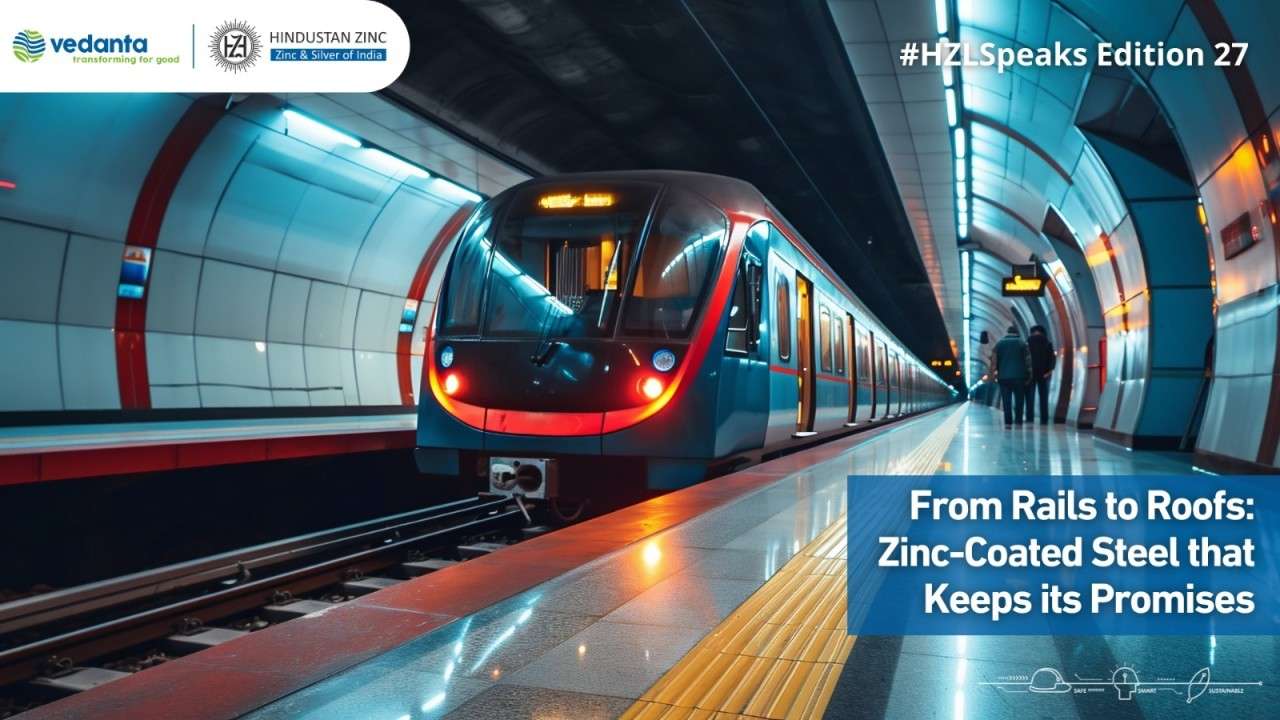
At its heart, galvanization is an insurance policy for steel. Zinc sacrifices itself to protect the metal beneath. Even when scratched, the coating corrodes first, ensuring decades of maintenance-free service. In most environments, galvanized steel delivers 50 years or more of durability—few human plans can make the same claim.
The phrase “from rails to roofs” captures both history and scale. In the 19th century, zinc-coated steel safeguarded ships and railway signals, where failure was not an option. Today, it supports the wider economy: transmission towers across states, solar structures holding panels in desert winds, road lighting columns, warehouses, homes, and factory roofs. Modern roofing systems now withstand winds up to 180 miles per hour, proving resilience in extreme conditions. The technology has traveled far, yet the principle remains unchanged: build once, repair rarely.
The economic case is equally compelling. India loses 2–4% of its GDP annually to corrosion—over ₹12 lakh crore (around $140 billion). Countries like Japan and Australia, which embraced zinc-coated steel early, have reduced such losses to a third. Studies indicate that up to 30% of corrosion damage is preventable with existing technology. Galvanization is not an exotic innovation—it’s disciplined application.
Hindustan Zinc has brought this truth to life through the #ZungKeKhilaafZinc campaign. Two motorcycles parked side by side—one rusting, one intact—made the invisible problem visible. With over 70% of a vehicle’s body made of steel, corrosion protection is not a luxury; it’s a necessity. And the cost? Less than 0.1% of a vehicle’s price, with payback in longer life, lower maintenance, and higher resale value.
Environmental questions are valid but require nuance. Hot-dip galvanization is energy-intensive, yet its long service life offsets initial inputs. Galvanized steel is fully recyclable, and lasting steel reduces the demand for new production. True sustainability lies in efficiency, not constant replacement.
As India builds at scale—railways, renewable energy, housing, mobility—the choice of zinc-coated steel becomes a policy decision, not just a technical one. Galvanized steel delivers something rare: durability that makes economic sense and serves national interest. Resolutions may fade, but zinc-coated steel will continue to keep its promise.
Selected sources
- World Corrosion Organization – Global and national corrosion cost estimates: WCO – World Corrosion Organization – Publications
- International Zinc Association – Zinc and galvanization in infrastructure
- Journal of Cleaner Production (2020): Life-cycle assessment of hot-dip galvanisation Life-cycle assessment as a tool to evaluate the environmental impact of hot-dip galvanisation – ScienceDirect
- Indian Railways / RDSO specifications on zinc-coated steel applications: rdso.indianrailways.gov.in/uploads/files/scan0004.pdf